
Elevators: A Design Lift


Style Editor Julie A. Palm chats with Brandon Architects about the unique design opportunities presented by the otherwise utilitarian elevator.

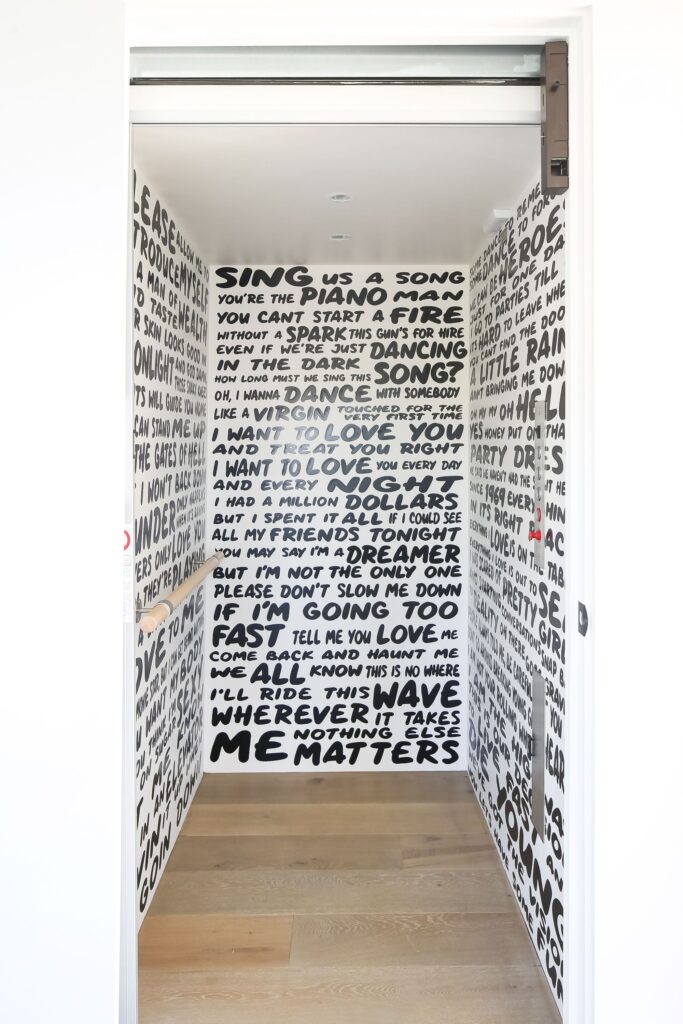
From left to right: With the addition of a framing glass panel in this elevator in Vail, Colorado, the wall became a canvas for a graphic artist. Photo: Jeremy Bitterman Lyrical and expressive, the art inside this elevator in Newport Beach, California, gives people much to ponder as they move between levels. Photo: Ryan Garvin
By Julie A. Palm
Brandon Architects is elevating the functional, practical elevator into a design canvas.
That might mean creating a focal point with a dramatic glass elevator, adding skylights to create a connection with the outside world, or turning the interior into a display of original art.
How did the company find a niche with high-end elevator design?
“In a lot of projects, we’re working with really limited lot size. Say in Newport Beach, California: You’ve got a narrow width, and you don’t have the space to have a large, expansive footprint,” explains Ryan McDaniel, a partner and director of design for Brandon Architects, based in Costa Mesa, California. “… So, in those homes, the elevator is taking up valuable square footage and isn’t something easily concealed or hidden. It really has to become something more than just a functional aspect and has to become a design feature.”
In some homes, McDaniel says, his firm ties the elevator to a staircase, “so it’s part of this overall large atrium and a focal point in the home. In other cases… it’s concealed but we want to make it a hidden surprise.”
That’s where things like custom artwork come in.
“We have one in Vail, Colorado, that is kind of eclectic,” McDaniel says. “You get inside the elevator, and there’s a skylight above it, and the back wall of the elevator is glass.”
The homeowner hired a graffiti artist to spray paint different scenes on the back wall, giving people a different view as they traverse the levels of the home.
“It’s a fun and quirky representation of that client — and a feature that was unexpected,” McDaniel says. “And that’s kind of our approach for it. Yes, an elevator is functional, but it can be this unexpected surprise that gets people saying, ‘Wow! What a cool space.’”
“There are a lot of customizations available, which we do in collaboration with our own interiors team or other interior designers we’re working with to design the elevator as an extension of the home,” McDaniel adds.
An elevator also gives interior designers an opportunity to create visual moments by considering what artwork, view, or vignette people will see on each level as the elevator doors open.
Brandon Architects specializes in custom luxury residential design, working in a variety of architectural styles. About 90% of its projects are new construction, allowing the firm to consider elevator placement and design early in the process. The majority of the firm’s work is in Southern California, but about 40% is spread across the United States, with some international work in countries including Mexico and the United Arab Emirates.
As a practical matter, Brandon Architects says the addition of an elevator is “certainly a conversation point” in any multilevel new residential construction project. That’s for several practical reasons, including the ease of moving things like luggage and groceries between levels of the home, aiding guests with mobility limitations, and, of course, helping homeowners age in place.
“There may be a slight increase in interest (in elevators) as people are really considering more and more this element of aging in place,” McDaniel says. “If you can accommodate a secondary primary suite on the ground level, that’s one solution. But in most cases, space is a premium and an elevator is really the best path … to address the idea that at some point, you’re going to be less mobile and you don’t want to have to leave your home.”
If homeowners are unsure about the utility of an elevator, one option is to build space for one (about 20 square feet), plus the mechanicals, so it can be added later if desired.
Prices vary, but residential elevators, McDaniel says, typically cost around $70,000, with glass systems closer to $100,000 or more.
When incorporating an elevator into a home, safety requirements and mechanical reliability come first. But “once an elevator meets the functional requirements, it really provides a unique design experience.” McDaniel says.
He loves the idea of people bringing visitors into their home and saying, “We can’t wait for you to use our elevator!”