


Emma Grace Bailey, director of sustainability for Future Snoops, recently gave brands and designers a pep talk for sticking with sustainability efforts, even in the face of tougher laws and growing consumer skepticism.
By Julie A. Palm
Brands and designers wanting to present customers and clients with sustainable home furnishings are up against difficult odds, not just trying to source sustainable products, but also dealing with legal pitfalls and consumer backlash.
That is according to Emma Grace Bailey, director of sustainability for New York-based consumer insights and trend spotting firm Future Snoops.

But those obstacles shouldn’t keep the home furnishings industry from continuing to move toward more sustainable products and practices.
Bailey recently hosted a seminar, “The Sustainability Perfection Trap,” encouraging participants not to give up sustainability efforts in the face of challenges.
“Sustainability doesn’t require perfectionism at all. It requires participation,” she said.
Bailey noted that proposed legislation and laws, including places like the European Union, Canada, and California, are cracking down on claims companies make about sustainability. At the same time, consumers and investors are more skeptical of sustainability claims. And fines for greenwashing are on the rise.
Both to meet new legal requirements and to maintain trust with consumers, Bailey recommended that companies not use terms like environmentally friendly, natural, biodegradable, climate neutral, and eco unless you can provide and communicate quantifiable evidence to back up those claims. The TLDR: Better to make specific, targeted claims than sweeping generalizations, Bailey said.
This is not just advice for manufacturers. It also applies to interior designers or retailers making claims on behalf of brands they carry, endorse, or use in projects, she added.
Under some legal requirements, “any business in the supply chain that either makes, repeats or passes on an environmental claim can be held responsible if that claim is found to be misleading,” Bailey said.
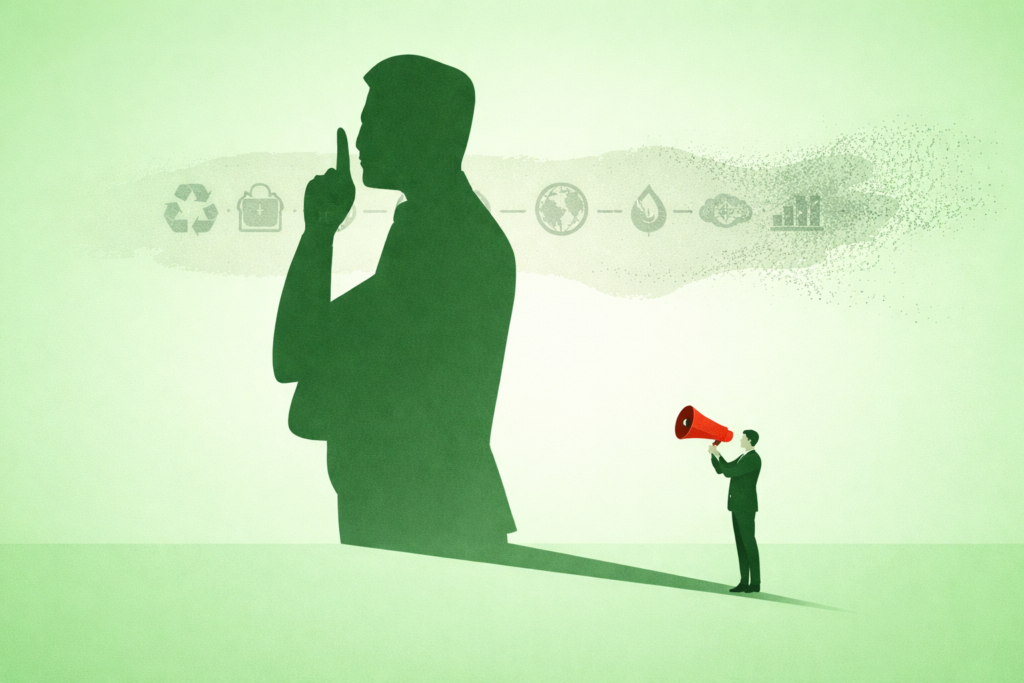
All these pressures can lead to another problem: greenhushing, or deliberate silence as companies stop communicating actions — whether genuine or not — for fear of scrutiny and greenwashing claims, Bailey said.
But by greenhushing, companies miss out on conveying valuable information to consumers looking for products that are more sustainable.
Greenhushing because of perfectionism, “is contributing to a huge lack of consumer trust through silence,” Bailey said. “… I can’t tell you how many times I’ve not bought from a brand because I can’t find a single shred of evidence that they care. When brands provide no public updates, have vague or outdated sustainability pages … consumers end up believing that they’re either not doing anything or that they’re hiding something.”
Other pitfalls of such perfectionism include delaying impactful decisions, which, in turn, reduces the chances for real environmental benefits.
Similarly, “the next risk is missed learning,” Bailey said. “So here, brands are fearful of testing new materials, new supplies, or processes. They will avoid those public pilots for fear of failure. … (But) it’s only with experimentation that you can make real progress, and if you aren’t asking those questions up front in the early days, you’ll never really move forward. … It will be slower and more expensive than for those who take action now.”
Bailey recommended companies take some time to assess their sustainability practices, focusing on a few initial tasks:
- Audit the language you use on websites, marketing/advertising materials, product/service descriptions, and elsewhere to remove “any absolutes or vague claims” regarding sustainability, she said.
- Document your sustainability processes and the progress you’ve made to date and publicize that “rather than just listing outcomes,” Bailey said.
- Track your decision-making thus far and share with consumers. For optimum transparency, you should also document — and explain — trade-offs you’ve made in your quest for sustainability.
- And, finally, Bailey said, “This is quite hard, but communicate one imperfect step. Start with honesty. Don’t be afraid to speak up, flaws and all.”
As regulations tighten and consumer expectations evolve, the path forward is about staying accountable. Companies that communicate with clarity, embrace transparency, and continue to iterate will be best positioned to build trust. In today’s market, sustainability isn’t about perfection—it’s about proof, progress, and participation.