




The Business of Self-Worth


Designer and author Johnathan H. Miller explores why pricing is less about math than mindset—and why that distinction changes everything.
There comes a point when advice given one person at a time begins to feel like a broken record. For designer, educator, television personality, and now author Johnathan H. Miller, that point arrived after years of watching talented interior designers underprice themselves—not because they lacked ability, but because they struggled to recognize and communicate the value of their own work. Rather than have the same conversation for the hundredth time, he wrote a book.

Outspoken by nature and a part-time provocateur, Miller is the CEO and Principal Designer at JSquared, an award-winning interior design and luxury staging company based in RIchmond, Virginia. He has a gift for turning conventional wisdom on its head and rarely holds back. “Why Underpricing Kills Design: How to Command What You Are Worth” is his most public expression of that tough-love approach.
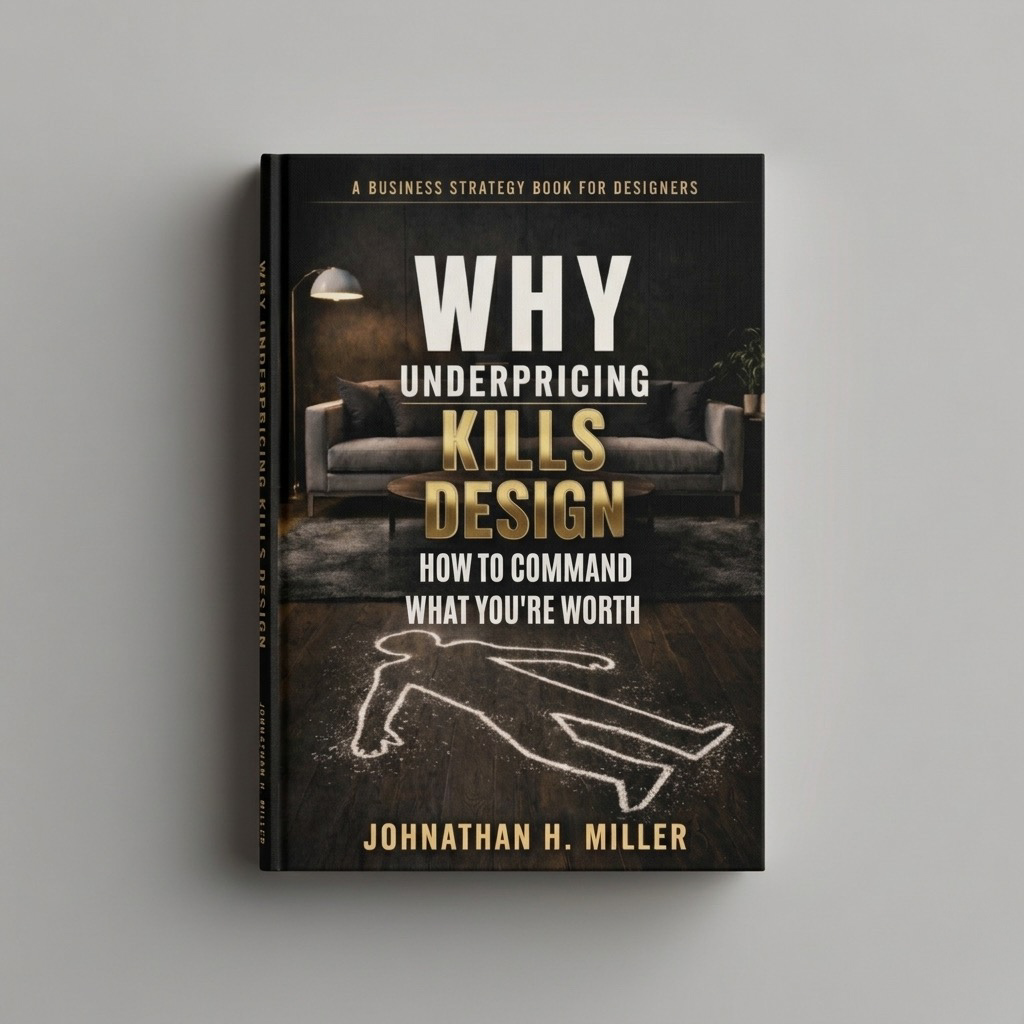
After years of watching talented designers work themselves into the ground for small margins, he decided one more conference panel wasn’t enough. The result is a book that is equal parts business manual, manifesto, and love letter to the profession. Tracing today’s pricing challenges to the long history of design being viewed as women’s work—valued for taste and emotion rather than authorship or expertise—he argues that language shapes value.
“Talent without authority is always underpaid. Not because the market is cruel, but because it responds precisely to how value is named and enforced. When work is described casually, it is compensated casually,” he explains.
Despite its title, “Why Underpricing Kills Design” is about far more than pricing. Complete with worksheets, formulas, and exercises, the book explores the relationship between self-worth and business worth, arguing that talented designers often undervalue themselves not because they lack skill, but because they haven’t fully embraced their role as business owners.
For Miller, pricing is the outward expression of that mindset. Designers, he says, lower their fees because they’d rather be chosen than negotiate, mistake fear for flexibility, or lean on the financial safety net of a spouse’s income or a side job.
“Pricing is never just math,” he writes. “It is an autobiography. It is a belief. It is a story you tell the market about who you are and how seriously you expect to be taken.”
The book is decidedly practical. Miller walks designers through the real cost of running a business and encourages them to price from financial reality rather than what feels comfortable. As he puts it, “You’re not charging for your time. You’re not even charging for your expertise. You’re charging based on what you think someone will say yes to.”
He also argues that strong customer service doesn’t require weak boundaries. “You can have great customer service with boundaries.”
In a surprising sideways twist, Miller ventures beyond the borders of the design and home staging industries to reinforce his message, to examine the payment structure of what is often called “the oldest profession.”
“Payment happens upfront and the provider doesn’t apologize for access.” Pointing to a designer’s penchant to offer free consults, he remarks, “Sex workers never make the mistake of ‘demonstrating without cost.’”
This isn’t the kind of work you read once and shelve. It’s the kind that gets dog-eared, highlighted, and revisited whenever old habits begin to creep back.

Miller is at a comfortable distance now from his old habits. “I had to have that reckoning myself. I wasn’t paying myself a real salary while making sure everyone else got paid. That’s not noble. That’s avoidance.”

His own business has become proof of the philosophy he advocates. Miller’s present business model incorporates interior design and renovation, staging, and furnishings sales. He executes on one luxury property from start to finish and has exclusive contracts with top realtors. Unapologetically, he says he is triple-dipping and covering all the non-negotiables of pricing: pay the business, pay the people, pay the owner, and protect the future.
The book took two years to write. Inside are practical tools—from pricing formulas and communication templates to scripts for saying “no”—designed to help designers translate confidence into everyday business practice. There are also plenty of pithy and profound one-liners destined to become Post-it affirmations.

Even after finishing the manuscript, Miller couldn’t resist adding one final chapter: “The Selfie Designer.” In it, he challenges designers who prioritize social media over sustainable business, arguing that “the designer who prioritizes a feed over a portfolio isn’t a business owner—you are a hired fan.” His reminder is pointed: “The most profitable jobs are often the ones you can never post.”
Readers may or may not agree with every one of Miller’s conclusions, but his larger challenge is difficult to dismiss. He wants to provide designers with tools to help create sovereignty and then legacy, byproducts of sound structure and boundaries.
Note: Miller will be on a High Point Market panel at Universal Furniture on Friday, Oct. 16 at 4 p.m. “Why Underpricing Kills Design: How to Command What You’re Worth” discussion led by Jessica Deuce; book signing to follow.