
Justina Blakeney’s ‘Grow’ Invites Designers to Cultivate Creativity From Within

Justina Blakeney has already written three interior design books — “The New Bohemians,” “The New Bohemians Handbook” and “Jungalow.” These glossy, photo-filled books featuring bold, colorful interiors and DIY tips earned her the coveted “New York Times best-selling author” designation.
But Blakeney’s books have always been about more than interior design. They’ve been about nurturing creativity, rule-breaking, and tapping into your essence.
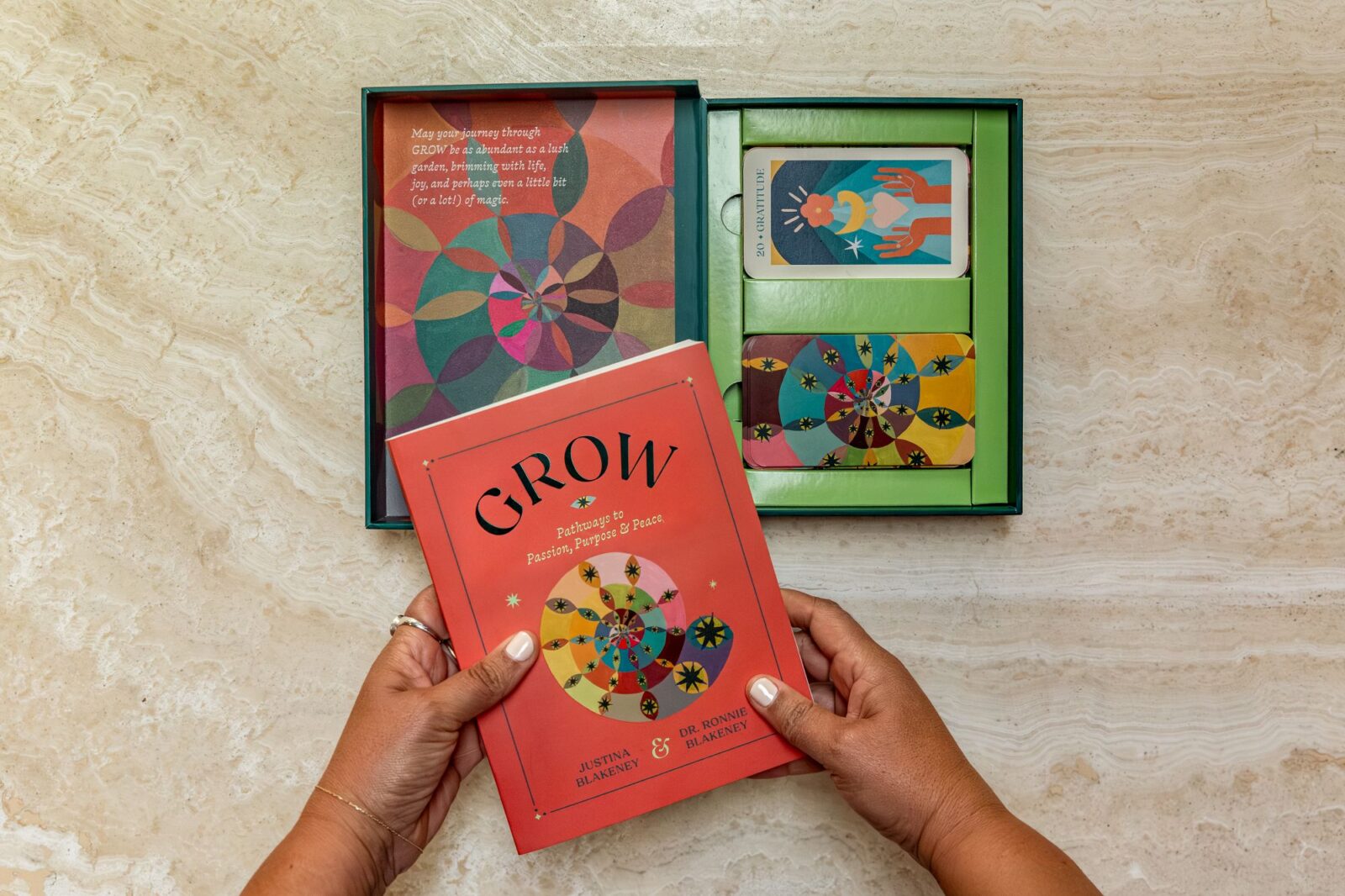
In her latest writing project, the interior designer and artist goes deeper into the realm of self-exploration. Co-written with her mother, Dr. Ronnie Blakeney, “Grow: Pathways to Passion, Purpose & Peace” is more than a book. It’s a spiritual guide: a set of 50 oracle cards and an accompanying “cosmic guidebook” that invites readers to delve into concepts like transformation, quiet, order, love, curiosity, boundaries, awareness, attachment, intention, gratitude, play and more. As you’d expect, “Grow” is well-designed: a neatly boxed set with a beautiful guidebook and cards featuring colorful artwork Blakeney painted over a span of six years.
I asked Blakeney about the project’s origins — and spent a week exploring “Grow’s” practices and guidance to see what pathways it might open for me.
Creative collaboration
“The idea for the ‘Grow’ oracle cards and guidebook grew out of my practice of pulling oracle cards as part of my morning ritual,” Blakeney told me. “I use them as a tool for reflection, creativity, and intention-setting. Over the years, the cards have really helped me look inward and find direction in moments when I’ve felt lost or stuck. As a deeply visual person, I found myself dreaming of creating a deck that paired meaningful guidance and practices with my artwork to help others tap into themselves.”
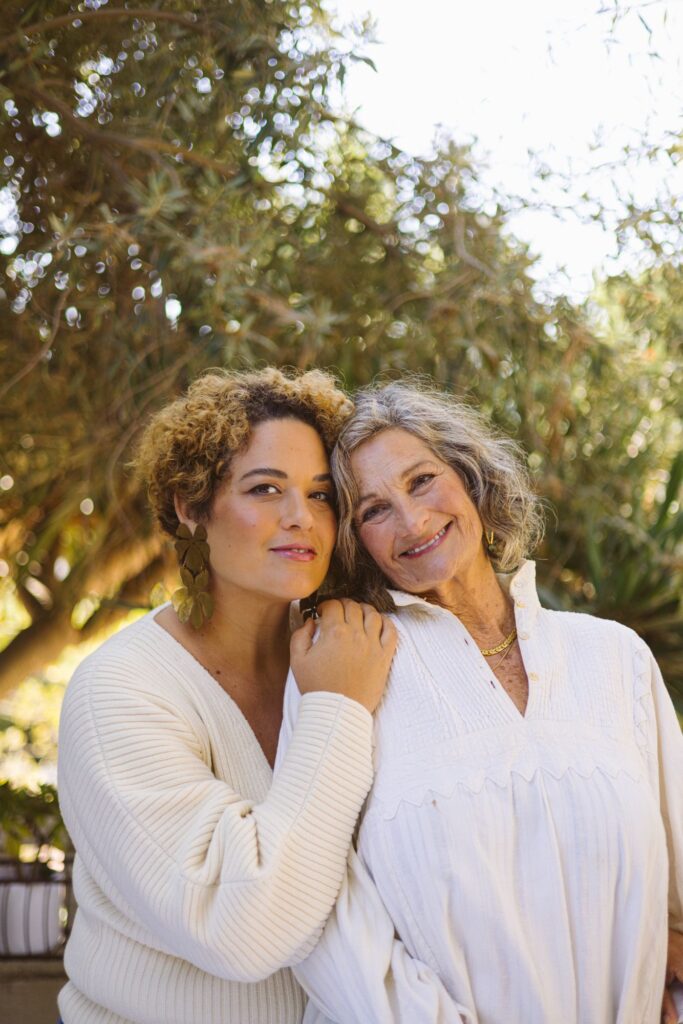
Blakeney brought her mom into the process as a collaborator. “Doing this project with my
mom felt like the most natural extension of that vision because she was my first real-life oracle,” she said. “… Together, we wanted to create something that feels like equal parts art book, creative companion and personal growth tool.”
Creating “Grow” took about two years, with the mother-daughter team meeting several times a week, developing concepts and drawing on their individual talents.
“The most beautiful part of the process was getting to know each other on an even deeper level through countless conversations and dedicated one-on-one time. Together, we explored the theme of each card, the stories we wanted to tell and the practices we hoped would genuinely help people grow. It was an incredibly fluid and collaborative process,” Blakeney said. “We each brought different strengths to the table. My mom’s work is grounded in a doctorate in psychology from Harvard, decades of research and a lifetime spent helping people grow. My background is in design, visual storytelling and the creative practices I’ve developed over the years to navigate my own challenges and cultivate a more intentional life. … Looking back, the process of creating it became its own growth journey for both of us.”
Putting “Grow” into practice
I’m not a user of oracle cards, which are somewhat akin to tarot cards, but I am a reader of personal development books, and I thought the best way to explore “Grow” would be to follow its suggested practices for seven days.
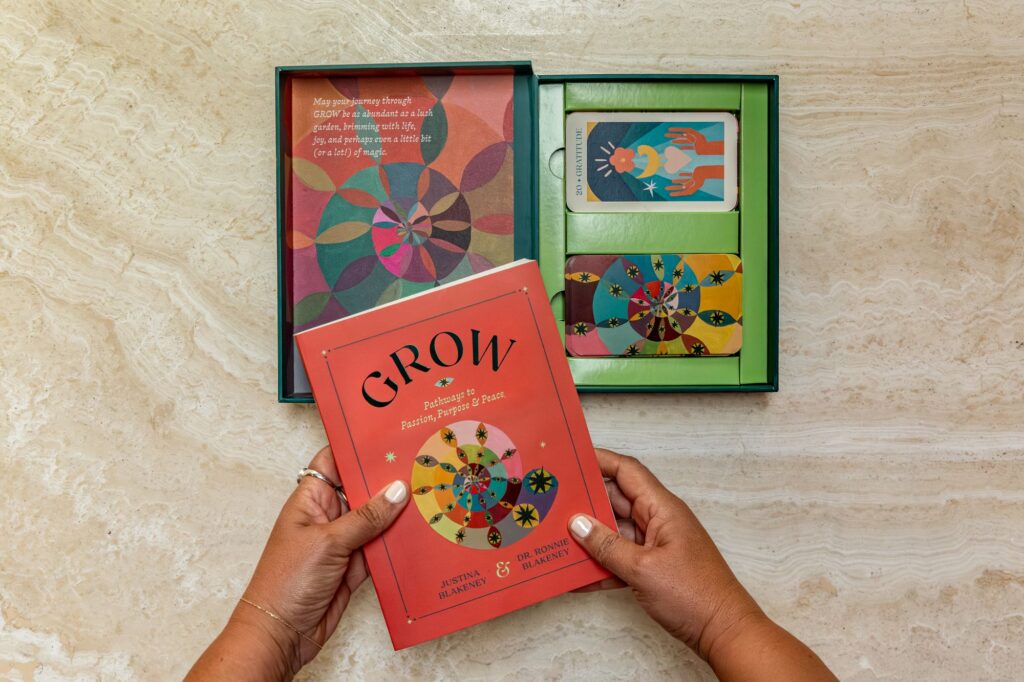
The Blakeneys offer several ways to use the cards and guidebook. The simplest way is to pull a single card from the deck and read the corresponding entry in the guidebook. Next levels include pairing the card with specific questions and pulling cards into spreads (such as three cards for past, present, and future, or four cards for an elemental spread representing earth, air, fire, and water).
I followed the simplest method: pulling a single card from the deck each morning. That, by the way, is how Blakeney said she uses “Grow.”
“My favorite way to use the cards is to pull one every morning as part of my daily ritual. I usually start by reading the ‘Invitation’ and carrying that idea with me throughout the day. If I have a little more time, I’ll also do the practice on the card,” she said, noting that she’d pulled the Synchronicity card that morning.
“Grow” practices can be done individually or as part of a group.
“One of my favorite traditions is sharing the card I pull with my mom and sisters in our family text chain,” Blakeney added. “We all send each other our cards each morning, and it’s become such a meaningful way to stay connected and see how we’re each growing in different ways.”
On the first day of my experiment with “Grow,” I pulled the Mirror card, one of two wild cards in the deck that represent “hidden aspects, fears or challenges you might be avoiding.” The book then directed me to pull a second card to “explore the shadow side of that arena.” I pulled the Belly card next — and immediately wanted to put it back in the deck. While pulling the Mirror wild card on my first day felt auspicious and intriguing, Belly didn’t resonate. I am a person who lives in her head and thinks of her belly only when hungry.
I turned to the Belly chapter of the guidebook. It, like the chapters for every card, includes an “Invitation” (an overview of what the card invites you to consider) and a “Get Curious” explainer that delves deeper into the concept. (And kudos to the authors: The “Get Curious” text, in particular, draws wisdom from a wide variety of faith traditions, cultural practices, and academic research, giving people from all backgrounds relevant entry points.)
About the Belly card, the guidebook told me: “The question you’ve grappling with cannot be answered with logic alone. It’s time to listen to your belly’s wisdom. Your gut holds deep, intuitive knowledge. Trust the flutters and knots — the belly offers guidance that does not change its mind.”
For each card, “Grow” suggests several practices, starting with “Observe,” typically a series of things for you to notice or questions to ask yourself. For Belly, the book suggests monitoring how your breath flows into your belly and encourages you to “notice how you respond to gut instincts.”
“Do you trust and follow your intuition or do you second guess it?” the authors ask.
Next, “Grow” offers an “Act” section for each card, often a specific ritual or a series of practices to do throughout the day. For Belly, I was encouraged to create a small altar, light a candle, and monitor my breathing while massaging warm oil into my belly.
The guiding chapter for each card ends with “Reflect,” a short series of questions about how you engaged with the exercises and what you have learned.
As I reflected that evening, I thought about how that initial Mirror card encouraged me to consider “what hidden wisdom would it reveal about the person I’m becoming.” Part of that, I realized over the course of the day, was that I need to live less in my head and listen to my gut as I make some tough decisions I’m facing.
The second day, I pulled the Abundance card, upside down — a sign, the guidebook told me, that I “might be overly fixated on material wealth.” “Widen your aperture to include what nourishes your spirit,” the authors suggest.
Day 3: I pulled the Rest card
Day 4: Quiet
Day 5: Calling
Day 6: Attachment
Day 7: Random Acts of Kindness
Each day, I read the accompanying guidebook, considered the Observe questions, and did at least one of the suggested practices in the Act section. I also journaled along the way because I process information through the physical act of writing.
The whole process took time, an hour or more over the course of the day, and I could have spent additional time because I found the questions and practices helpful and could have explored each day’s card even more. Over the course of seven days, I gained some insights. I looked at aspects of my life differently. I even had a few revelations.
Because of that, I might make “Grow” part of a weekly practice rather than daily to give myself time to think more deeply about the cards I pull.
That is one of the strengths of “Grow.” It’s flexible, adapting to your needs: Dip a toe in, or dive in deeply. Practice daily, or pull a card when you’re facing a creative conundrum or vexing problem.
A tool for interior designers
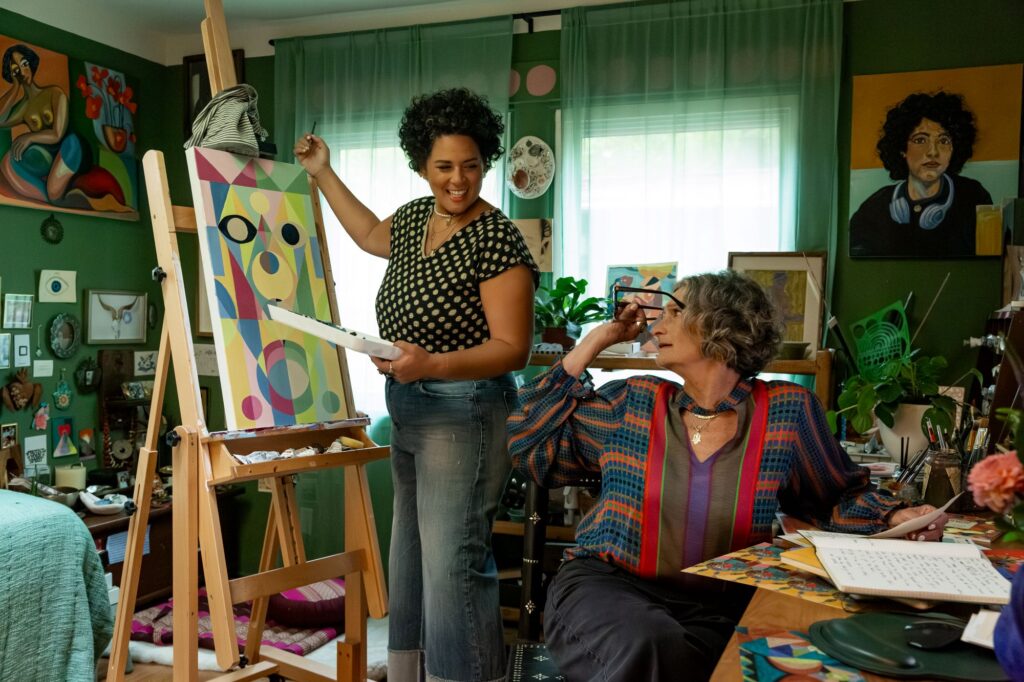
I asked Blakeney how interior designers and others in the home furnishings industry might use “Grow” in their own lives.
“I think ‘Grow’ is especially relevant for creative people,” she said. “Designers spend our days solving problems, making thousands of decisions, balancing client needs with our own visions and constantly searching for fresh ideas. That kind of work asks a lot of our creative energy. For me, the cards are a way to reconnect with curiosity, intuition and play — all of the things that fuel good design in the first place. Sometimes the practice on a card sparks a new perspective. Other times it’s simply the artwork, a color combination or an unexpected prompt that nudges me out of a creative rut.”
I love the idea of designers delving into “Grow,” not only on their own as part of a daily centering practice but perhaps as part of a weekly staff meeting or annual retreat.
“At the end of the day, I believe the most meaningful spaces are created by people who are continually growing themselves. When we’re more present, more self-aware and more connected to what inspires us, that naturally shows up in the work we create,” Blakeney said. “I hope ‘Grow’ becomes a small daily ritual that helps people nurture not just their creativity, but themselves and in turn, the communities we are all a part of.”
Note: Header image credit Lisa Kelley Remerowski