
This and other design ideas gleaned from Kips Bay Palm Beach 2026.
By Jane Dagmi
When I lived in Florida, I tried never to miss the Kips Bay Decorator Show House Palm Beach. And now that I live in North Carolina, I make the effort to attend every year.
Always a treat for the senses (and a very successful fundraiser benefitting the Kips Bay Boys & Girls Club and Boys & Girls Clubs of Palm Beach County), this year’s event featured two one-story midcentury residences in the Northwood Shores neighborhood: a 4,500-square-foot waterfront home and a smaller cottage just across the street.
I visited on a Sunday morning eager to soak in beauty and meet the designers. Packed with color, creativity and countless design ideas, like its Northern and Dallas counterparts, the designers here layered their spaces with texture, pattern, sculptural form, incredible art, and a delicious serving of iconic Palm Beach—motifs and materials that vibed ritzy to relaxed, nostalgic and new.
Here six design firms shed light on their unique spaces and how they came to be.
Architectural Mirage by BAMO
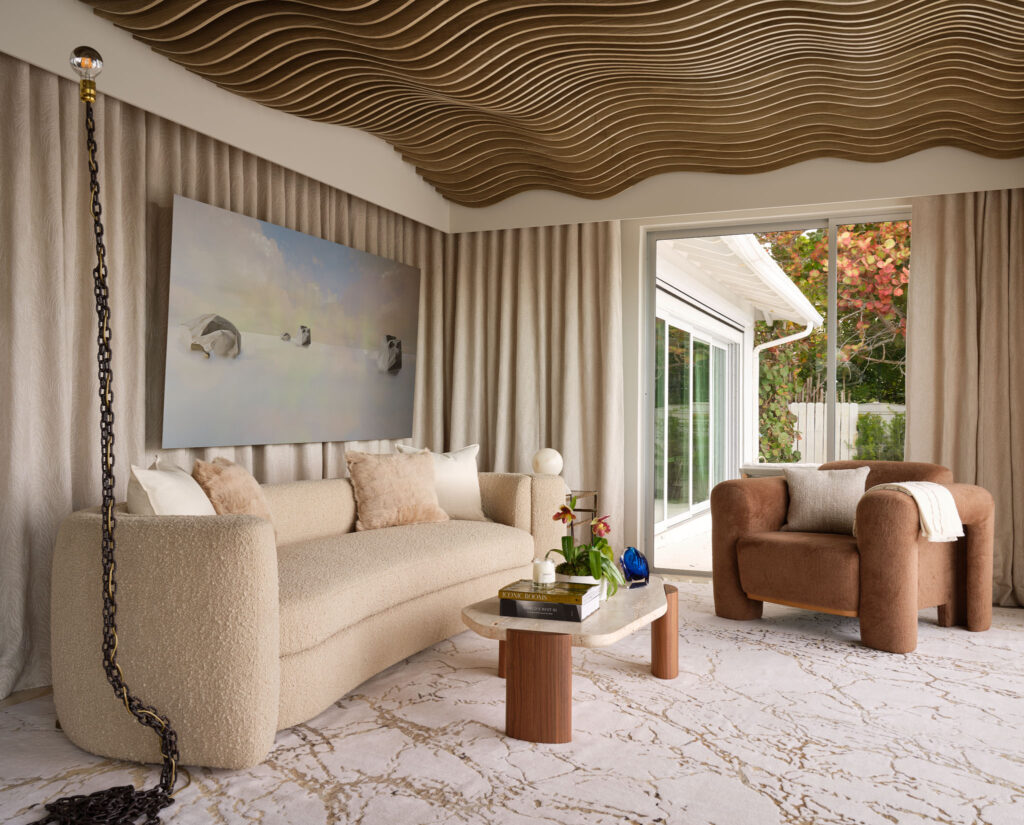
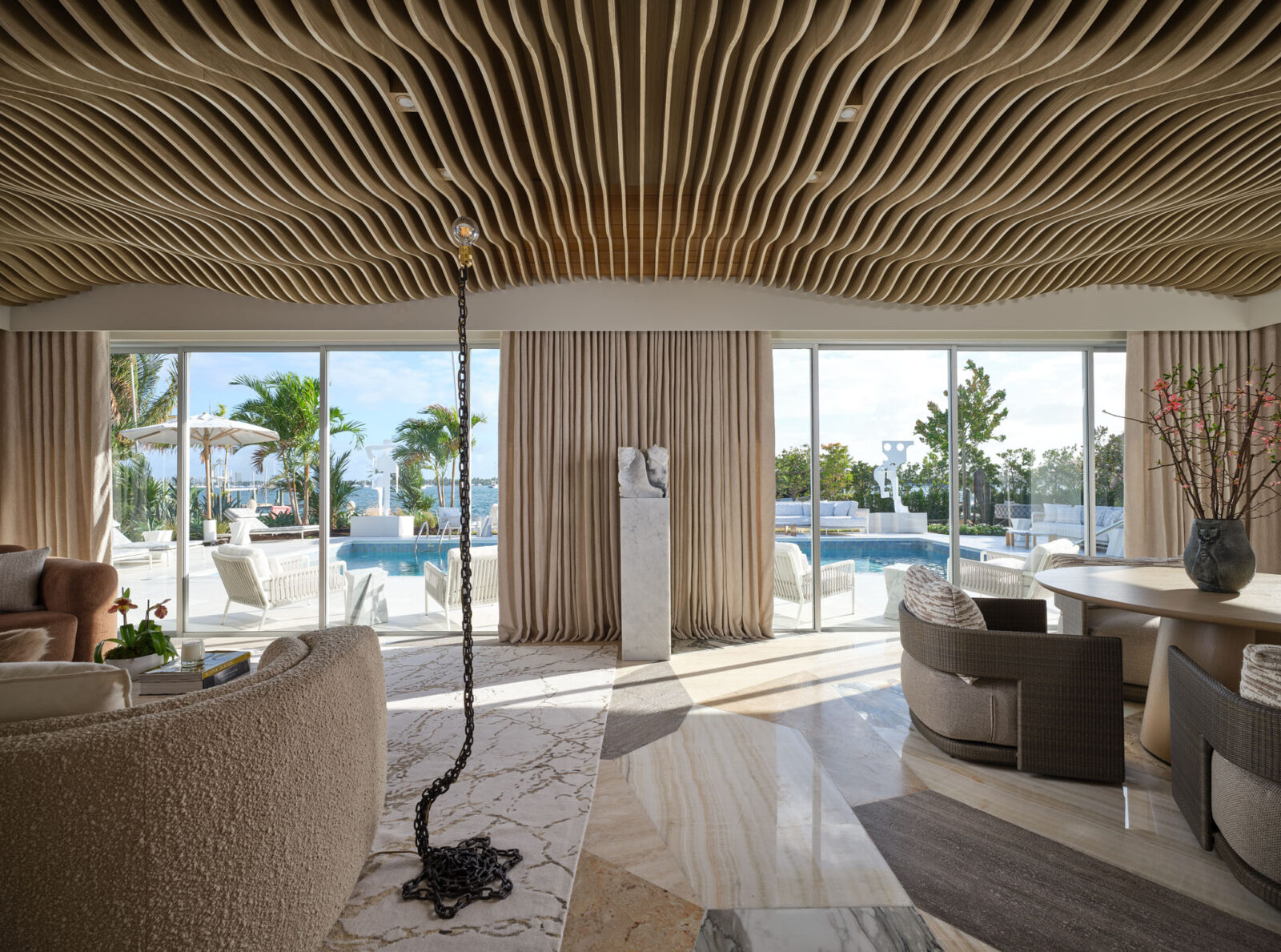
I stopped in this space and took a breath. Up, down and sideways, I was surrounded by intention: the angles in the stone floor juxtaposed with the soft folds in the drapery whose rhythm echoed the mesmerizing ceiling. There was stillness and there was movement. I asked BAMO principals Anne Wilkinson and Sergio Mercado about their space:
Q: You’ve applied your creativity to properties around the world. How did you stretch your imagination and skills for Kips Bay?
A: The design of the ceiling was something new we wanted to explore. The concept began as a smooth undulating ceiling. Upon presenting this to our contractor it became apparent it was unachievable within our time frame. Our millworker suggested we consider what we could design using their CNC machine. That’s when the idea came to mind. Install the wood paneling to the ceiling vertically. The CNC machine can cut the bottom of the panels to create the undulation we were envisioning. What began as one concept evolved. Designing within parameters engages us to explore new concepts. —Sergio Mercado
Q: Much like the ceiling treatment dissolves the flat plane of that surface, so does the drapery shroud the walls. How many yards of fabric were required?
A: We needed 120 yards of fabric to drape the room. The fabric is from Harlequin, which is a Sanderson Design Group Company, and the fabric is aptly named Formations! —Sergio Mercado
Q: If AI tried to recreate this room, what’s the one ingredient it would probably miss?
A: In my experience working with our team in AI, it’s still a limited tool. If a furniture item has been modeled in 3d then the program is able to make it mostly look accurate in form. But AI renderings generally lack the subtlety of color and texture that is uniquely important to the feel of our monochromatic space.—Anne Wilkinson
·Q: What has been the most amusing comment overheard in your space?
A: One lady said, ‘The ceiling looks like it’s moving when I walk’, and her friend added ‘it probably really moves after a few drinks’. There weren’t the only ones to wonder how it looked under the influence. —Anne Wilkinson
The Breakfast Club, After Hours by Amy Young Designs
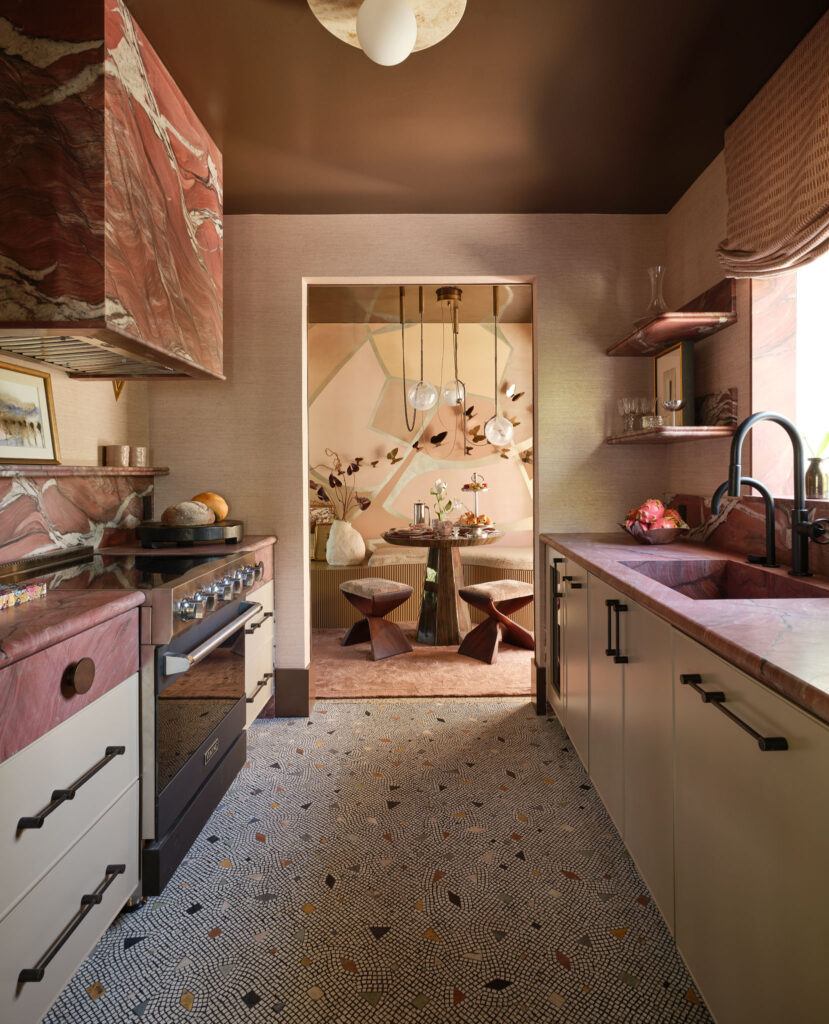
In the cottage, the kitchen’s modest footprint, was the perfect constraint for designer Amy Young of Amy Young Designs to employ a palette of deep rich tones and hone in on creating a luxury experience that felt like a boutique hotel bar. She explains.
Q: What was your starting point for the design of the kitchen?
The starting point was the honed Velour quartzite from Primestones in a beautiful maroon tone. The slab immediately caught my eye. It had this incredible warmth and depth of color and movement that immediately felt special. From that moment, the room evolved into a jewel-box concept where we layered jewel tones, different metal finishes, and fabrics so the kitchen feels less utilitarian and more like an elegant boutique hotel bar where you might sit down for an espresso martini.
Q: What is one detail that quietly impacts the space that may get overlooked?
The hardware from Nest Studio is one of those details that quietly elevates the entire room. I often describe hardware as the final piece of jewelry in a space. It may be small, but it’s what ties everything together and gives the design its finishing sparkle.
Q: What do you love about stacked bullnose edging?
The double-stacked bullnose detail felt like a classic element with a bit of a twist. Bullnose edges are inherently timeless and soft, but layering two together adds an unexpected sculptural quality. It’s a subtle detail that brings dimension.
Q: What has been the most amusing comment you’ve heard about your space?
Not really a question or comment but sometimes people will open our fridge and just take a water bottle or soda from it thinking it’s for grabs. In reality, it’s all part of the styling for the space, so it’s always a slightly amusing moment when we have to explain that the refreshments are purely decorative.
The Gathering Place by Yarn Design Associates
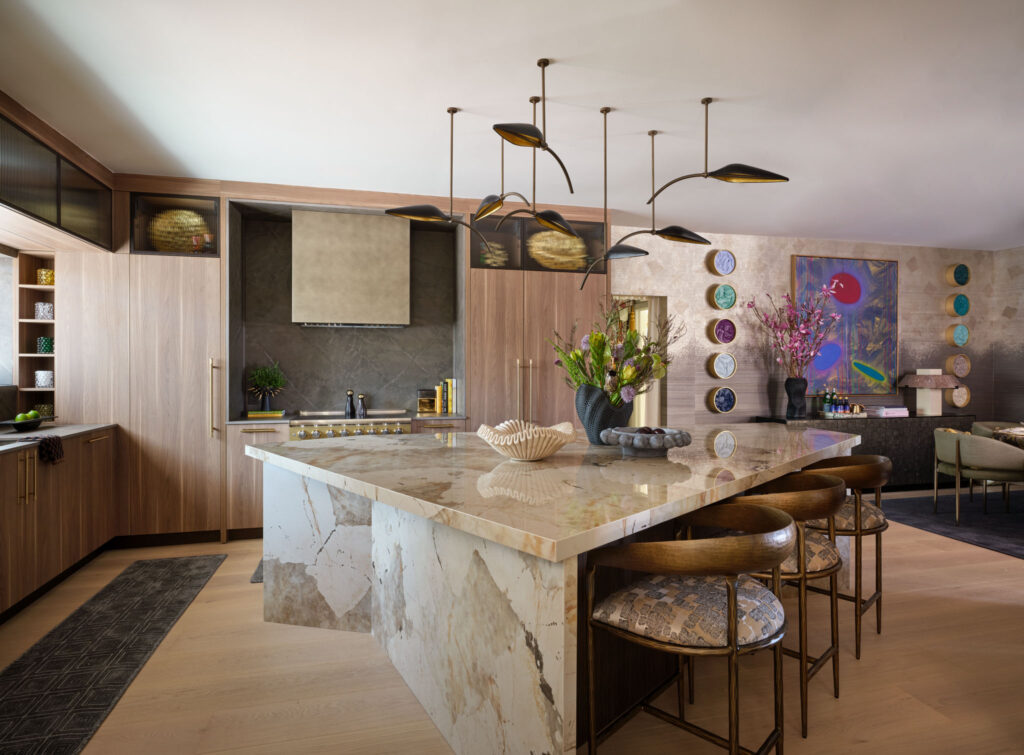
Adjacent to a large artful great room, Yarn Design Associates’ Gathering Place serves as a modern hearth of the home—a destination that includes kitchen and dining. With a sexy mix of warm metals, sculptural lighting, and sleek cabinetry setting the tone, it’s the impressively scaled Dekton by Cosentino–clad triangular island that becomes the room’s main conversation piece. Principal Leanne Yarn-Alcalay explains her choices.
Q: How did this island come to be?
A: I settled on the shape of the kitchen island due to size and layout of the existing footprint. I knew I needed to do something unusual for the show house to get people talking…yet I wanted to show to the public that you can achieve something outside the box that is still usable for every day.
Q: How did you venture beyond your comfort zone?
A: I pushed the boundary of creativity with a healthy budget for design! Since my company is the one paying for it, I could showcase to the public what we are capable of achieving when budget doesn’t hold us back. I also worked with some incredible vendors that were willing to lend custom-made pieces for our spaces and offered me almost anything I wanted out of their showrooms.
Q: Beyond aesthetics, what else was on your mind when partnering?
A: Having converted and married into a Jewish-Israeli family, and in light of current events in the world, I felt it was important to support fellow Jewish-owned brands and creatives in my industry.
Q: If AI tried to recreate this room, what would it probably miss?
A: The vision we imagined with the interesting cuts and angles of the porcelain slabs to create our kitchen island would never have translated the way I envisioned it through AI. As much as we love it to save time, those finer details almost never seem to translate.
Terra Calma and Patio do Sol by Firefinish Interiors
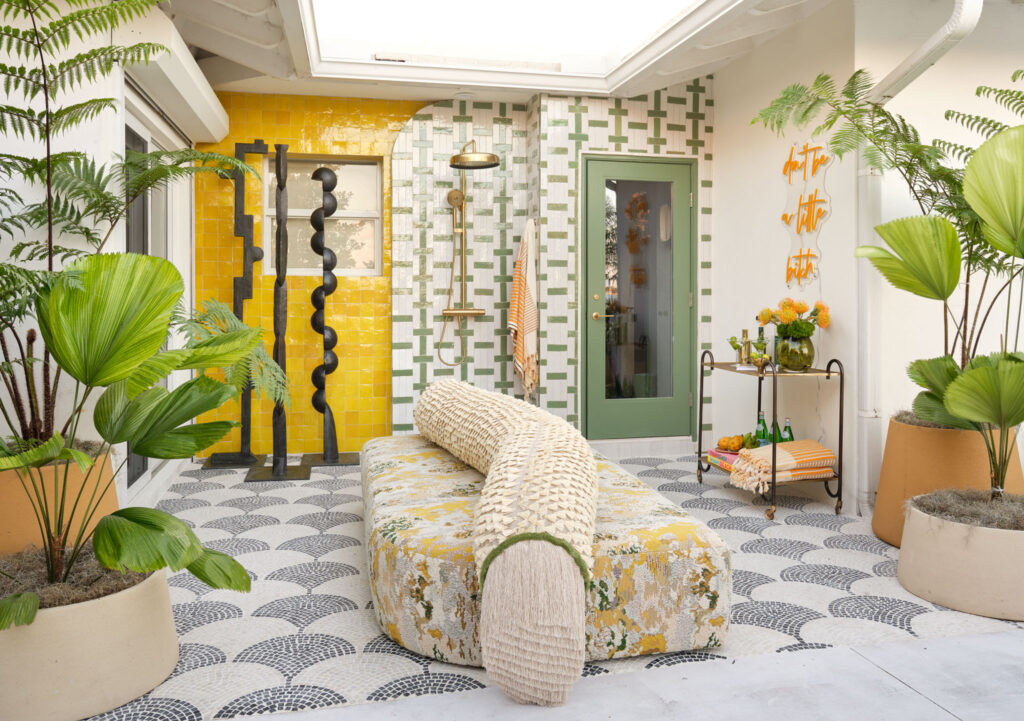
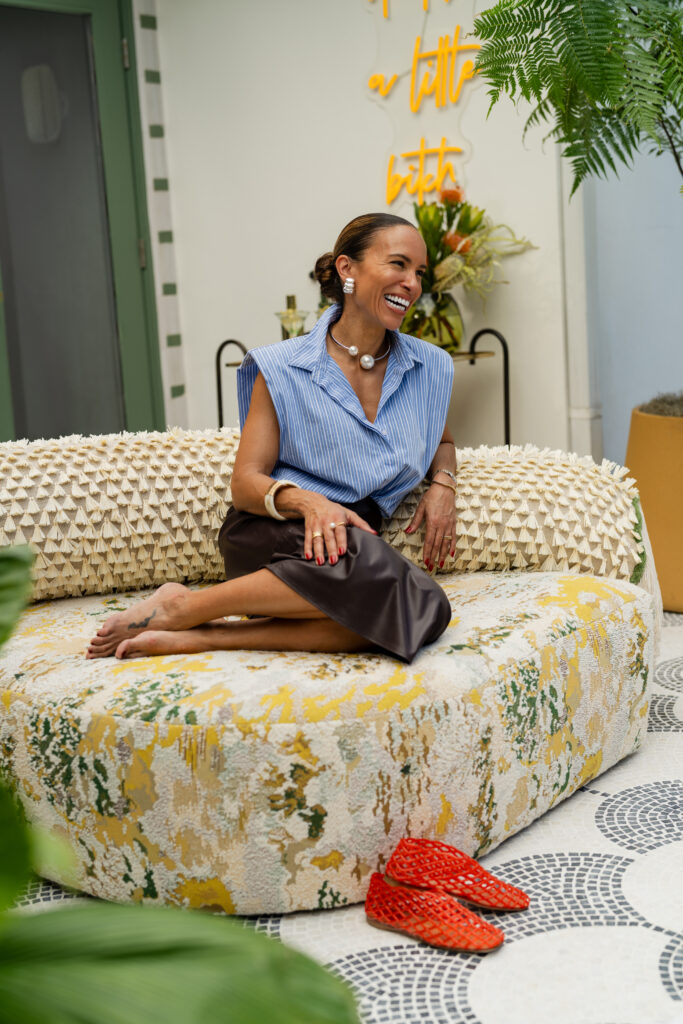
Combining a pattern-rich array of tile and stone with a bold citrussy palette, Rayana Schmitz of Firefinish Interiors delivered an indoor/outdoor spa experience that is sophisticated but not too serious. She tells us about creating it.
Q: How did Kips Bay cause you to flex your creativity and explore new territory?
A: We have designed outdoor showers before, but we’ve never had the opportunity to have quite as much fun with one as we did at Kips Bay. Typically those spaces are smaller or more restrained. For this project we really took the opportunity to color outside the lines. While we love working with neutral palettes, and that’s what most of our portfolio reflects, we wanted to use this moment to show how we approach color and playfulness within our design language.
Q: What was your starting point for each space?
For Terra Calma, the starting point was the tile pattern. We customized the colorway to bring in the modern Palm Beach interpretation we wanted to explore. For Patio do Sol, everything began with the yellow Zellige tile. From the start we knew we wanted both spaces to feel joyful and uplifting.
Q: If AI tried to recreate this room, what’s one ingredient it would misinterpret?
A: Such a great question. It would probably miss the nuance of natural materials. With natural stone, every slab is different; you can still recognize the material, but the tones always vary.
Q: Is there some detail in this room that has great impact, but may get overlooked?
A: The curved ceiling. Not everyone catches it, and honestly that means we did our job well. It’s actually solving a problem. There was an awkward transition from a 9-foot ceiling down to 7 feet because of a structural beam. We designed what we call ‘the wave,’ a curved ceiling detail that softens and disguises the change so it feels intentional.
Q: What has been the most amusing comment overheard?
A: ‘Need me a Mike Wazowski light’—that’s a Monsters Inc. reference to the one-eyed round green monster.
The Champagne Conservatory by The Lewis Gallo Design Group
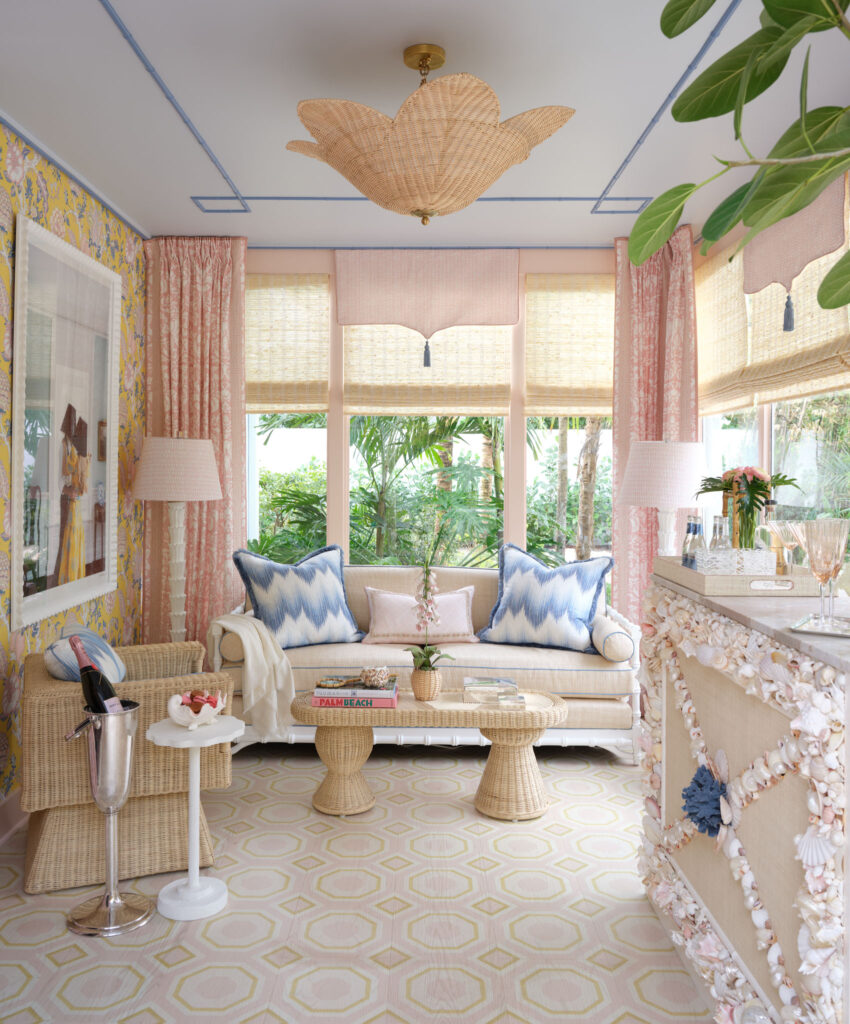
An homage to classic Palm Beach pattern and tropical colors, the mother-daughter team at The Lewis Gallo Design Group, Barbara Lewis and Meredith Lewis Gallo, respectively, turned this posh sitting room into a space to sip and celebrate.
Q: Who’s the artist behind the photo?
The photograph is by local artist Nick Mele, whose work captures the playful, glamorous spirit of Palm Beach in a way that feels very modern.
Q: Why did you select this particular artwork?
A: Nick’s photographs are always love at first sight. His work has a quirky, cinematic quality that immediately caught our attention, and this particular image paired beautifully with the wallpaper in the room. It felt fresh and modern against the more traditional patterns in the drapery and wallcovering.
Q: How does it affect the vibe of the space?
The photograph adds a wonderful sense of humor and playfulness to the room. It creates a great juxtaposition with the more traditional elements and keeps the space from feeling too serious or fussy. Instead, it feels relaxed, fun, and very Palm Beach.
Q: What is one detail that quietly impacts the space that may get overlooked?
The ceiling is essentially the ‘fifth wall’ of the room and creates a huge impact. It adds another layer of pattern and texture, but unless someone looks up, they might completely miss it.
Q: If AI tried to recreate this room, what’s one ingredient it would likely miss?
AI might be able to replicate the individual elements, but it would likely miss the nuance of the layering—the balance between playful and polished. The room works because of the subtle tension between the traditional patterns, the whimsical shell bar, and the humor of the photography. That kind of intuition is hard to replicate.
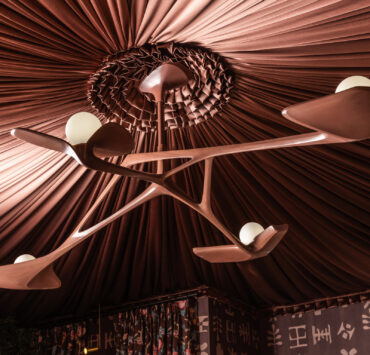
The Mahjong Lounge by LTA Interiors
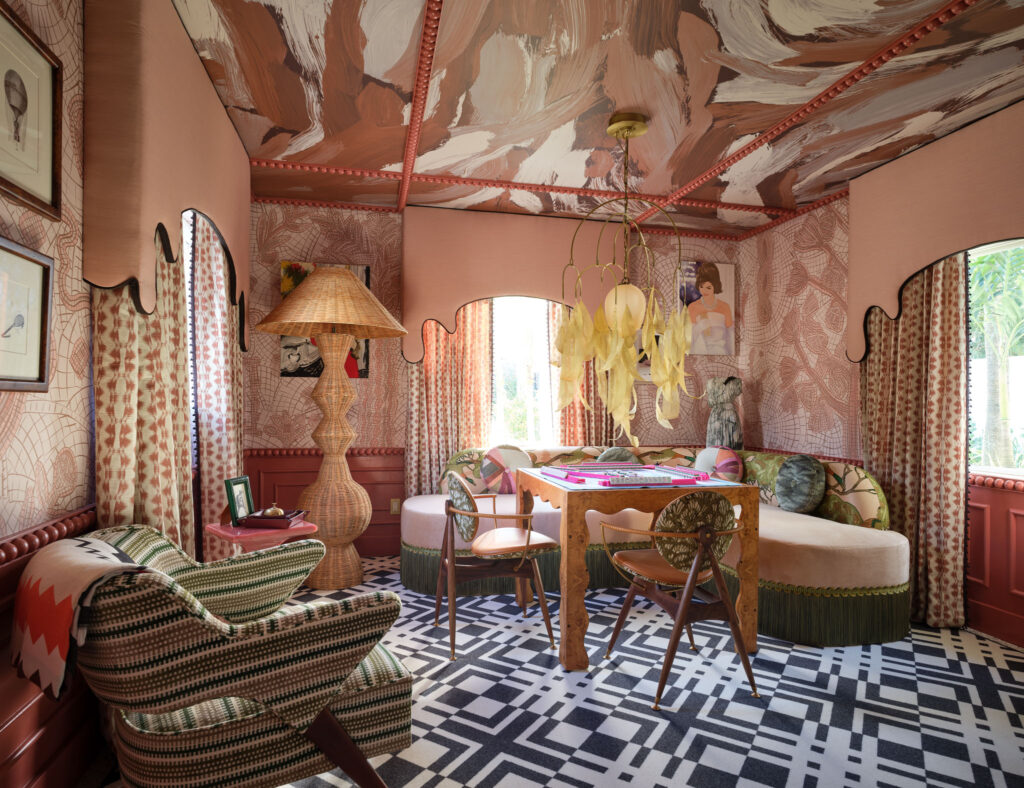
For the LTA Interiors team—Lynn Berney, Tracy Gould and Alexa Evans—Mahjong was the muse, inspiring a maximalist play of color, pattern, and scale that transforms the nostalgic game into a rich three-dimensional experience. Lynn explains more on behalf of the group.
Q: What was your starting point for this space?
A: The idea of mahjong as an experience rather than simply a game. We wanted to design a glamorous gathering space that celebrates friendship, femininity, and the ritual of women coming together. Mahjong has evolved from a traditional social pastime into a modern cultural moment, and we wanted the room to reflect that balance between old-world social tradition and a bold, contemporary sensibility.
Q: So, what was your first design move?
A: We focused on creating an immersive environment where conversation flows easily, competition feels playful, and guests want to linger for hours. The layered Calico wallcoverings became the visual foundation of the design. Using Mosaic Tessera on the walls and Ensemble Resonance on the ceiling allowed the space to feel wrapped, dimensional, and richly textured, setting the tone for the entire scheme.
Q: And from there came all the other layers! What’s your process?
Our approach to mixing patterns is a balance between thoughtful planning and intuition. We begin by establishing a strong visual foundation and then layer patterns in a way that feels rich and intentional without becoming overwhelming. Sculptural furniture— the burl wood mahjong table and curved seating— and jewelry-like pendants act as focal points and ground the space. Custom window treatments add softness and architectural interest, reinforcing the idea that successful pattern mixing relies on layering structure, texture, and scale to create a cohesive and expressive interior.
Q: If AI tried to recreate this room, what would it miss?
A: AI might be able to replicate the colors, patterns, and individual pieces, but it would likely miss the subtle sense of intuition behind how everything is layered together. The room is built on small, intentional decisions about scale, texture, and emotional atmosphere that come from human experience. I don’t think AI would understand how a space should feel when people gather, laugh, and spend time together.
Q: Is there a detail that impacts the space greatly, but may get overlooked?
A: Not the color or pattern itself, but the power of the ceiling treatment. While people often focus on the furniture or lighting first, the ceiling quietly shapes the atmosphere and makes the entire room feel more cohesive and enveloping.
Q: What have you found most amusing while hanging in your space?
A: Guests wonder whether they’re actually allowed to sit down and play mahjong. People immediately want to interact with the space, which we love because the entire concept was built around the social ritual of gathering and playing together.