



You’re Already Doing the Work. Are You Getting Paid?

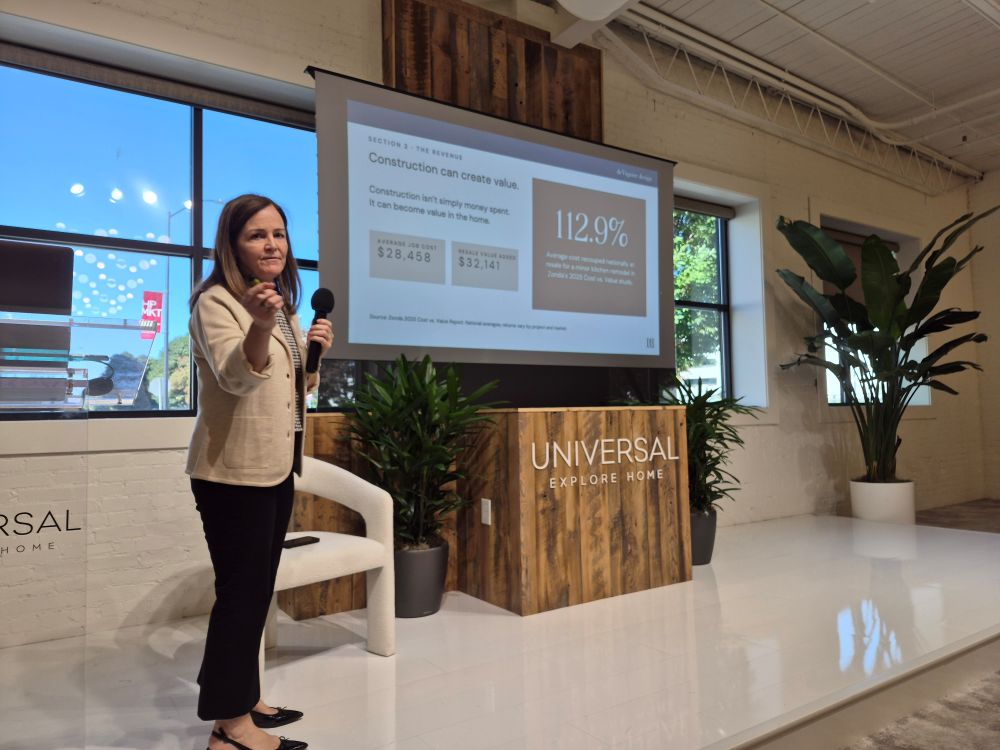
Renée Biery challenges interior designers to recognize the value of construction management—and turn overlooked work into a deliberate revenue stream.
At the recent High Point Market, interior designer Renée Biery asked a standing-room-only crowd at the Universal Furniture showroom how many of the designers gathered are doing construction management, whether on whole-home new construction projects or on smaller kitchen or bath remodels.
The vast majority of hands went up.
“So, the revenue is likely already in your projects: You’re just not billing for it. You are already reviewing contractor bids. You’re answering job site questions. You are definitely coordinating trades, especially on the smaller projects, right? You’re solving problems. You’re managing changes and you are, of course, protecting your design intent. That’s what we do. We just don’t charge for it. We don’t charge enough for it,” said Biery, founder of deVignier Design, based in Montchanin, Delaware. She’s also the host of “The Only Girl on the Jobsite” podcast and creator of The Designer’s Edge, a construction management program for interior designers.
Biery’s seminar, “Construction Management: Your New Revenue Stream,” was part educational how-to and part pep talk.
“We’re absolutely necessary”
Homeowners truly benefit when interior designers take on construction management, Biery said. Clients may see architects, engineers and general contractors as indispensable — and interior designers as less so.
But, she told the audience, “We have superpowers that nobody else on that job site has. … We know how people live. We know how they flow through spaces. We know what they need, when they need it and how they need it. We are good with people. I am not throwing architects and contractors under the bus. I promise. We need them. We can’t do what we do without them. (But deeply understanding homeowners) is not their superpower.”
Architects tend to look at a home as a puzzle, Biery continued: “How do I create a five-bedroom, four and a half bath with an eat-in kitchen, a mudroom and a three-car garage?”
But interior designers know the intimate details of the homeowners’ lives: what side of the bed they sleep on, what they do first thing in the morning, how many of their children play travel sports, how often they have people over for dinner, if they hang their jeans or fold them.
Interior designers know not just that the homeowner needs a mudroom, but how many cubbies and hooks it requires, and whether it needs space to unbox Amazon packages or room to store all the food and accessories for the family pets.
And designers know those lifestyle details must be considered along every step of the construction process to create the spaces homeowners want and need.
But because gathering that knowledge is part of what interior designers do every day, they tend to downplay how valuable their skills are.
“We don’t give ourselves credit,” Biery said. “It’s on us to show our value as to why we’re absolutely necessary.”
Growing revenue
Deliberately offering — and charging appropriately for — construction management isn’t just about getting paid for work that designers are already doing, Biery said. It’s also a way to diversify revenue streams and demonstrate value in a world in which homeowners can type a prompt into an AI chatbot to receive “interior design” in an instant and then shop online for the furnishings. And it’s a more resilient part of the business during economic downturns, when people may be willing to invest in home renovations that will pay off when they sell their homes later but may be less eager to spend money on new furnishings.
In a good year, Biery said, about 70% of her firm’s revenue is construction management and 30% is “pure decorating projects.”
“And let me dispel something (for people who want to keep decorating too),” she said. “There is not a single construction project I have ever done in 33 years that I didn’t decorate. You decorate no matter what.”
In a theoretical example, Biery showed that designers can essentially double their fees if they add construction management to their design services.
Biery encouraged designers to charge the same hourly rate for construction management as design — and, as a practical matter, to keep those hourly rates and estimated hours off documents presented to the client. Instead present a total construction management fee.
“I’ve been communicating my value (to the client) the entire time, and by the time they see that number, they’re like, ‘Yeah, I get it,’” she explained. “It doesn’t mean that they sign off on it, but if they say, ‘I can’t do this number.’ No problem. I say, ‘Let’s go to the scope of work and see what we’re going to pull out.’” (More on the importance of the scope of work shortly.)
Consulting vs. managing
There is, Biery noted, an important distinction between construction management and consulting.
“Showing up when someone has a question on a job site is not construction management. You are consulting. Consulting is when you’re answering questions. ‘Hey, Renée, I need help. Can you stop over? Something’s wrong. … I need you to come to look at it.’ … Managing is owning the process. You are absolutely on site at every weekly meeting. You are on site at other times for touchstones, whether … it’s the plumbing rough-ins, the electrical rough-ins. … You’re talking about budget. You’re talking about schedule. You’re following decisions through. You are holding that design intent from day one.”
Specifically, construction management, Biery said, involves:
* Reviewing bids line by line
* Running preconstruction meetings
* Clarifying the project scope before work begins
* Coordinating trades and decisions
* Making real-time decisions on-site
* Documenting changes
* Protecting the design intent
“You’re not simply charging for design, you’re taking responsibility for risk, coordination, decision and execution,” Biery said.
Not every interior designer feels comfortable managing construction, she said. And that’s fine. “Do the consulting. Absolutely, be there if that’s where you’re comfortable,” she said. “Absolutely do it, but price appropriately.”
Biery cautioned designers to check regulations in their state — and the states in which they work — to determine the best language to use to describe their construction management work. The wording may need to be tweaked so they don’t run afoul of regulations for licensed general contractors. You may need to describe the work as construction supervision, construction oversight or project management.
The importance of the scope of work
The three key parts of construction management are the scope of work, the budget and the schedule and Biery focused on the scope of work, an area that some designers struggle with, she said.
When defining scope of work, or a contract proposal, for a client, Biery cautioned against using broad or subjective wording like “functional” and “sanctuary.” Scope of work language should be concrete, focused and concise — a list of bullet points with “zero adjectives,” she said. Look at contract proposals from architects and general contractors because that’s what homeowners will be comparing your proposal to, Biery told the audience.
“When we give them flowery pink paper with logos and 17,000 pages that have nothing to do with anything, we look ‘extra,’” she said. “Don’t be extra — or don’t be surprised when they say, ‘This feels extra’ and kill your proposal.” There are times for all that pretty marketing, she said. The scope of work is not one of them.
“Make it seem serious because it is serious,” she said.
“If a homeowner says, ‘I thought this is what the contractor was going to do?’ that is very normal,” she said. “Here’s what you say: ‘Why don’t you go read their scope of work?’ or ‘Let’s look at it together … and see what they’re going to do.’”
Another pro tip: Don’t attach dollar signs to line items. Price the project in total, knowing that deleting one line item doesn’t necessarily make the project cheaper. That change could lead to more work for you. Use addendums to adjust the scope of work as needed if the project evolves, Biery said.
“At the end of the day,” she said, “You want the homeowner to be like, ‘Damn, you’re doing a lot of work.’ There’s your first win.”